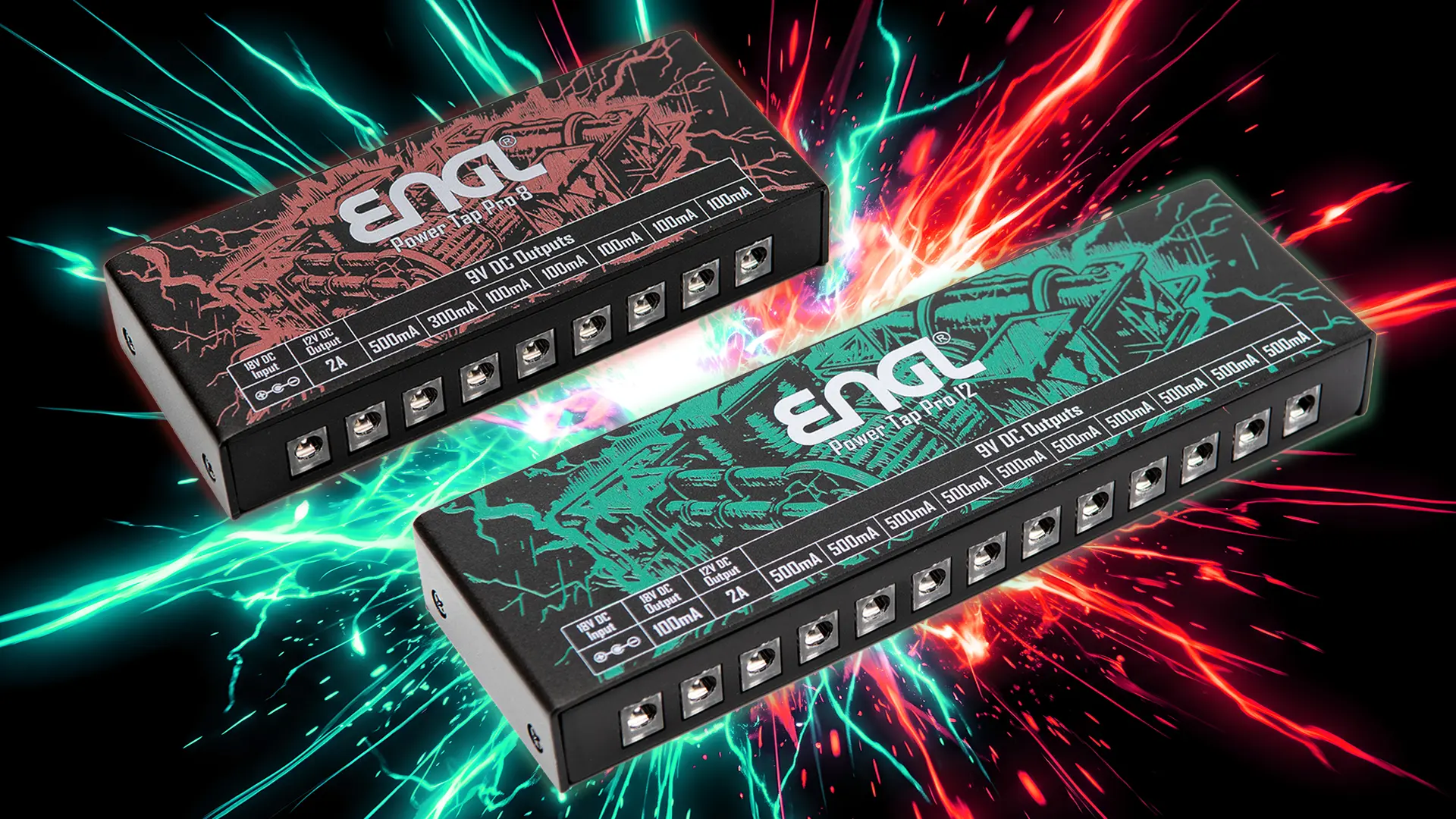
When it comes to building a pedalboard a basic understanding of power is absolutely essential. Forums and groups are filled with posts about what the numbers mean, whats does mA mean, why one sounds noisy and another is silent, should smoke be coming out the back etc etc. Ok maybe not that last one so much. So we have gathered the essentials in one place – hopefully this blog will serve as afairly straightforward reference you can come back to whenever you’re scratching your head. There is also a good reason to publish it today – we are introducing two new power supplies: the ENGL Power Tap Pro 8 and the Power Tap Pro 12. Both are built on exactly the principles laid out below, so once you understand how pedal power works, you will see precisely why we made ’em the way we did.
What voltage do your pedals need?
Most pedals, ENGL’s included, are designed to run at 9V DC, centre negative. All three of those things matter: nine volts, direct current, and centre-negative polarity. Get any one of them wrong and, at best, the pedal simply will not work – at worst, you will damage it. This is particularly true of any pedals that use a voltage doubler circuit as many Klon clones do. A handful of pedals will happily take 18V. The extra voltage gives the circuit more “headroom”, which can open up a little more clarity and dynamic range. It is not “better” as such, it’s just different, and only ever an option where the pedal is designed for it. If in doubt, 9V is always the safe reference point. Most pedals will have a marking of 9V DC (like the ENGL EP635 Fireball IR Pedal) indicating 9V is the maximum or 9-18V DC meaning anything from 9V to 18V is safe to use.
What do the mA mean?
If voltage is the first number on a power supply, current – measured in milliamps, or mA – is the second. It is simply how much power a pedal draws to do its job.The useful thing to understand is that a pedal only ever takes what it needs. Connect a pedal that draws 30mA to an output rated at 500mA and it will quietly take its 30mA and leave the rest untouched. You cannot overload a pedal by giving it more capacity than it asks for. So if you daisy-chain a few well-behaved drives from a single output – say 30mA, 15mA and 25mA – your total draw is 70mA, comfortably inside that 500mA rating. If you do daisy-chain pedals together you will get varied results depending on the types of pedal – so it’s always good to test both configurations before committing the wiring and cutting off those cable ties! I touch on this in depth a bit later.
One rule of thumb worth keeping: leave some room. Drawing right up to an output’s limit can pull the voltage down very slightly, and that small sag can change the way a pedal sounds. Staying below around 60 to 70 per cent of an output’s rating keeps everything stable and predictable.
Centre negative, and why DC matters
Centre negative describes the polarity of the barrel connector (usually 2.1mm). The inner pin is negative and the outer sleeve is positive – the opposite of what intuition might suggest, but it is the convention the pedal world settled on long ago, so it is worth getting right.
Just as important is DC. Pedals take direct current, not AC. Put AC into a DC pedal and you will hear a pop, quite possibly see a wisp of smoke, and then be looking at a repair.There is protection built in to limit the damage with most reputably built pedals, but it is a safeguard rather than a cure, and incorrect power is rarely something a warranty will cover. So the habit worth forming if you are changing your power supply for your board is simple – check the voltage, check it is DC, and check the polarity.
Why isolated power matters
Isolation means giving each output its own separate, electrically independent power feed. Why does that matter? Because some pedals interfere with others. Power supplies that are not isolated are essentially the same as daisy-chaining your pedals to one supply. Digital and modelling pedals in particular tend to dump noise onto the shared ground, and your gain pedals will happily amplify it. The result is the dreaded hum, hiss or high-pitched whine that quietly ruins so many otherwise awesome boards.
If you are running a chain of well-behaved analogue drives and distortions, daisy-chaining them from one output is usually fine. Introduce a digital delay, an IR pedal or a modeller, though, and isolation can be the difference between a silent board and a noisy one. As a general rule: the more you isolate, the quieter your rig. Every output on both new ENGL Power Tap Pro supplies is fully isolated for exactly this reason.
Two new supplies, built on these principles
Everything above is why the Power Tap Pro 8 and Power Tap Pro 12 are designed the way they are.
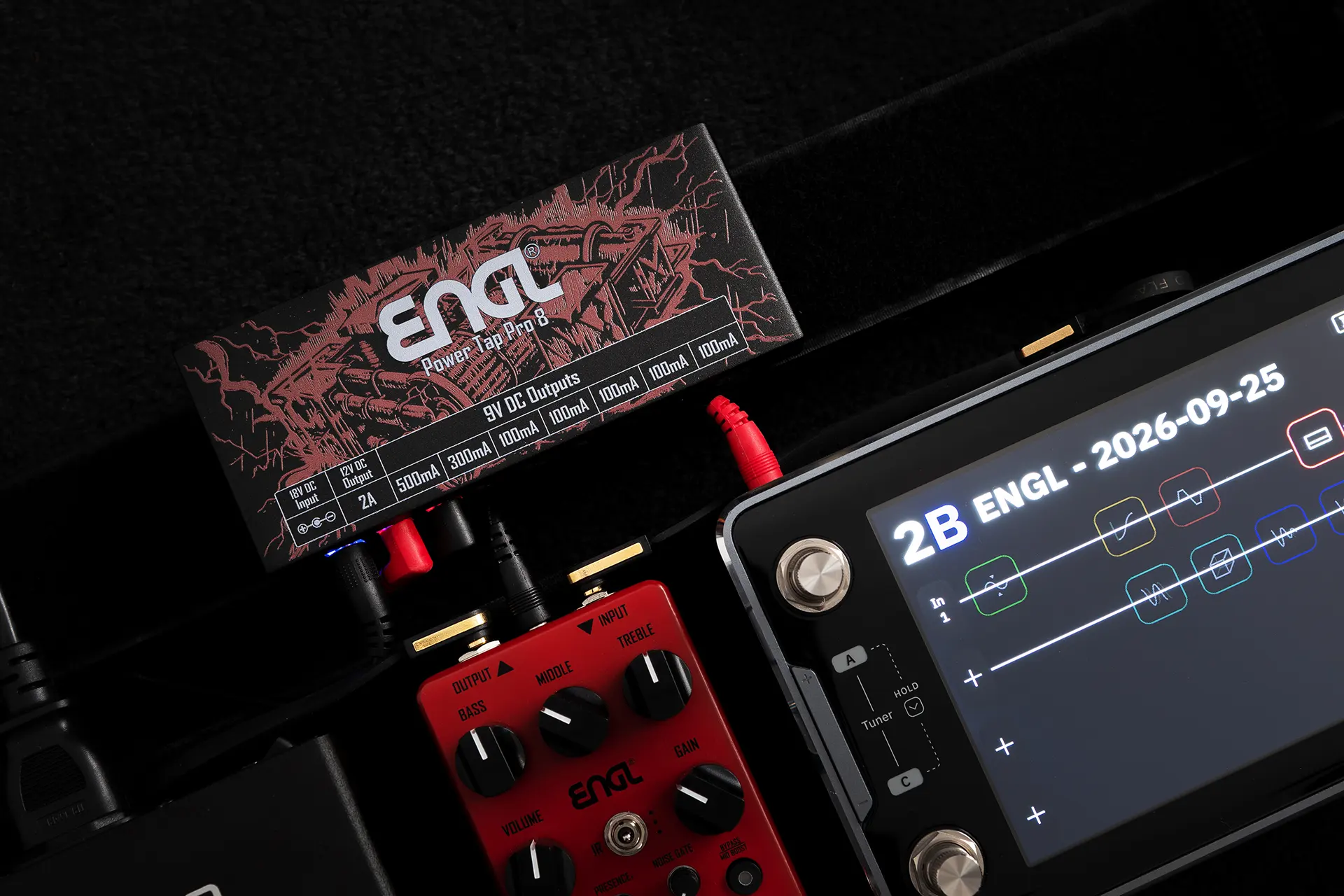
The Power Tap Pro 8 gives you eight fully isolated outputs in a compact, pedalboard-friendly enclosure. Alongside its 9V outputs – one at 500mA, one at 300mA and five at 100mA for analogue pedals – it carries a high-current 12V/2A output for a modelling processor or another power-hungry digital unit. Ultra-low-noise circuitry keeps the signal clean, short-circuit and overload protection keeps everything safe, and an LED on each output shows you at a glance which pedals are drawing power.
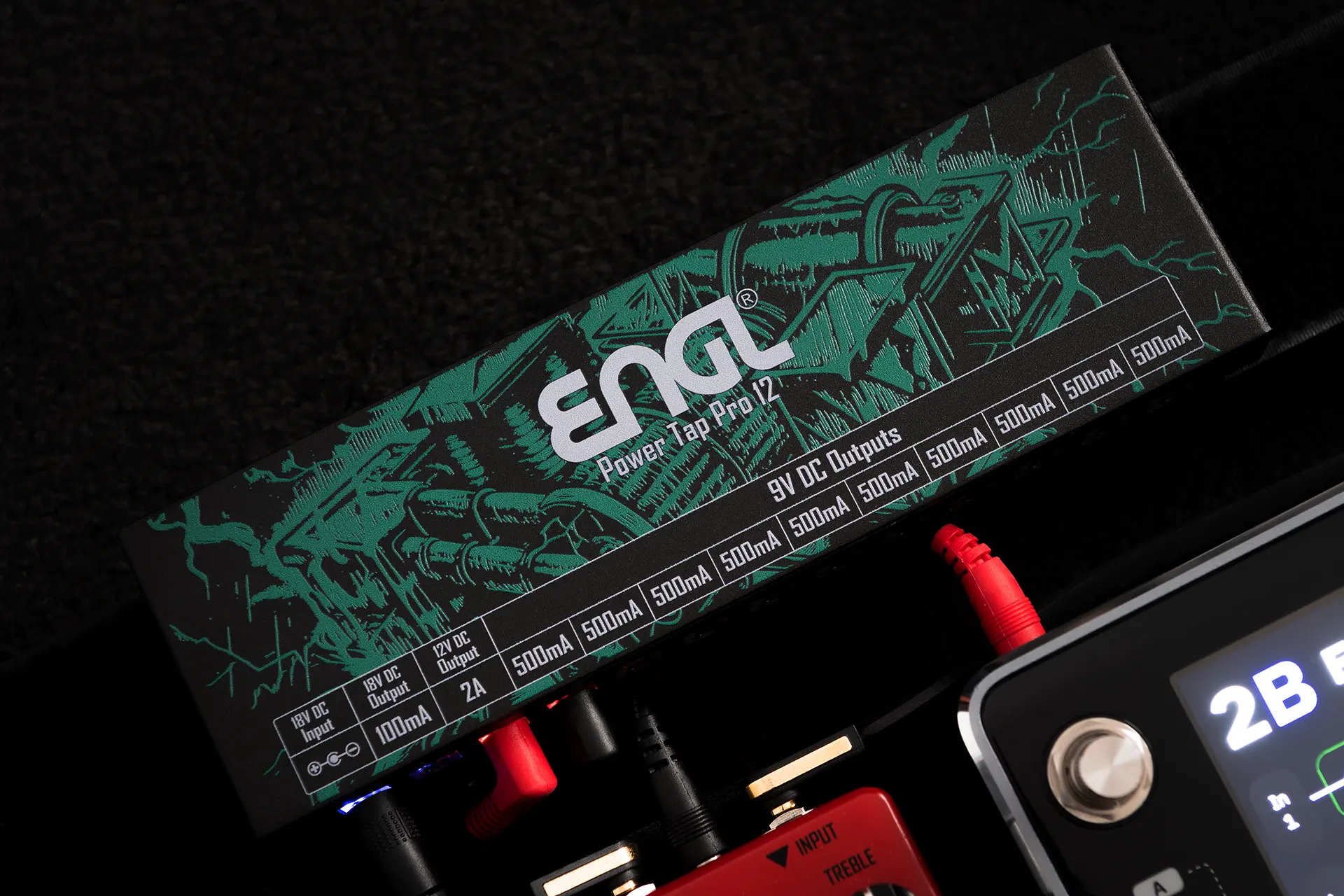
The Power Tap Pro 12 scales that same thinking up for larger boards: twelve fully isolated outputs, ten of them 9V at a generous 500mA, plus the same 12V/2A high-current output and an additional 18V/100mA output for pedals that want extra headroom. Same ultra-low-noise design, same protection, same per-output LEDs.
Both are available now from authorised ENGL dealers. And both are built to do the one thing a power supply should do above all else – stay out of the way, so all you hear is your tone.